Red White Blue

Sunday, April 21, 2013

Transition: From the House of Stuart to the House of Hanover

Prince James: An Impolitic Heir Apparent: Years 1660 - 1673

To understand how Anne, the second holder of the title Princess Royal, came to be, one must first understand the transition of the English monarchy from the House of Stuart to the House of Hanover.

Anne Hyde, Duchess of York; King James II by Peter Lely
James Stuart, the younger brother of the first Princess Royal, Mary, and of Charles II, had two surviving daughters by his first wife, a commoner, Anne Hyde, who he had controversially married in 1660. Both daughters, Princess Mary and Princess Anne (not to be confused with Anne, Princess Royal), had been raised Protestant, on the orders of Charles II, James's elder brother and the successor of their father, Charles I. Before Anne Hyde's death in 1671, James had converted to Catholicism, in opposition to Charles II's wishes. In 1673, James's conversion became public when he refused to follow the Test Act, to the dismay of Parliament and the English public.

Mary of Modena by Simon Pietersz

Then, in 1673, James married a beautiful, 15-year-old, Italian, Catholic princess, Mary of Modena. The notoriously xenophobic English public feared Mary of Modena could be an agent of the Pope. The public was even more concerned about the unpopular marriage of the brother of the king, given that Charles II and his wife, Catherine of Braganza, were unable to have children. What if James one day succeeded Charles II? Not only would Britain have a Catholic ruler (horrors!), but could even end up with a Catholic dynasty!

Mary's Marriage and the Succession of James II: Years 1677 - 1688

In 1677, James reluctantly consented to the marriage of his daughter, Mary Stuart, to the Protestant William of Orange, and Mary left for the Dutch Republic, leaving her younger sister, Anne Stuart, behind in England. In 1685, Charles II died, ironically after having converted to Catholicism on his deathbed.  He was succeeded by his impolitic younger brother, James II. Tensions rose further when Mary of Modena gave birth in 1688 to a healthy heir, James Francis, in effect, placing Mary and Anne after James Francis in the line of succession. English law allowed women to inherit the throne only if they had no brother. England was actually more liberal than many other European nations/provinces, such as Hanover, which did not allow women to inherit territory, or crowns, at all.

In case you're wondering why James II's daughter, Mary Stuart, was never created Princess Royal, the reason is this: She married William of Orange in 1677, becoming Princess of Orange, eight years before her father's succession to the throne of England. She already had her title.

Family Tree of James II, including his children, Mary, Anne, James Francis, and Louisa Maria (Ancestry.com):


The Glorious Revolution and "Succession" of William III and Mary II: Years 1688 - 1689

Prominent Protestants, including Princess Anne herself, claimed the new heir was "suppositious", alleging he had been smuggled into the birth chamber in a warming pan (a highly unlikely scenario). Within seven weeks, a group of seven Protestant nobles invited William of Orange, Mary's husband, to invade England, which he subsequently did with Mary's support four months later.

Detail of William and Mary from the ceiling of the Painted Hall
by Sir James Thornhill; photo by James Brittain
Bewailing the disloyalty of his daughters, James II fled England, taking up residence in France, the country where he had lived during his exile following the deposition of his father, Charles I, and where he eventually died in 1701. Parliament pronounced James II to have abdicated his throne and declared Mary II and William III joint rulers of England. Bowing to many of William III's initial demands, Parliament agreed he could reign singly, in the event Mary predeceased him, thus delaying Princess Anne's eventual succession (and making her royally angry in the process). Parliament also passed the  Bill of Rights of 1689, which declared no Catholic could ever ascend the throne of England and that no English monarch could ever marry a Catholic.

The Succession of Queen Anne and the End of the House of Stuart: Years 1702 - 1714

Queen Anne and William, Duke of Gloucestor 
by studio of Sir Godfrey Kneller
Whether one views this change of monarchs as an abdication followed by a succession or as a usurpation, the fact is, it eventually led to the end of the House of Stuart. Princess Anne, James II's younger daughter, had married George of Denmark, in 1683. During her marriage, Anne had 17 pregnancies, but only five surviving children. Four of these died before the age of two. Anne's remaining son, William, lived to be 11, dying in 1700, likely of hydrocephalus. Anne's elder sister, Mary II, had died childless in 1694. William III continued to rule after Mary II's death, but never remarried. Therefore, upon William III's death in 1702, Anne was the only person remaining in the line of succession established by the Bill of Rights
of 1689. By the time of Anne's husband's death in 1708, she had no living
children. By the time of her own death in 1714, and thanks to the Bill of Rights of 1689, there was no one from the House of Stuart, at least no Protestants, left to inherit the English throne.

The Succession of George I and the Beginning of the House of Hanover: Year 1714

Family tree of Elizabeth, 
Queen of Bohemia (Ancestry.com):
However, Parliament had seen this coming. In 1701, Parliament had further tested the flexibility of the laws governing succession, while safeguarding England from any dreaded Catholic restoration. In the Act of Settlement of 1701, Parliament bypassed over 50 Catholic claimants more closely related to Anne (including Anne's probable half-brother, James Francis), stating the throne would go to the Protestant descendants of Elizabeth, Queen of Bohemia and elder sister of Charles I (please see first post). Elizabeth's daughter, Sophia, married the Elector of Hanover in 1658. Sophia's eldest son, George, became heir to England's throne when his mother predeceased him. Although Sophia had famously quipped, "What Parliament does one day, it undoes the next", George I did ascend the throne in 1714 at the age of 54, founding the royal House of Hanover.

Sophia Dorothea, Princess of Hanover with her children,  
George and Sophia Dorothea by Jacques Valiant
By the time of his succession, George I had already had a pretty eventful life. He had entered into a loveless, arranged marriage with his first cousin, Sophia Dorothea of Celle, in 1682 (not to be confused with his mother, Sophia). He had had two children by Sophia, George Augustus and Sophia of Hanover (yes, a third Sophia), in 1683 and 1687, respectively. He had had three children by his royal mistress, as well. He and his wife, to whom he was physically abusive on at least one occasion, had become estranged. George probably had conspired to have his wife's lover, a Swedish count, murdered and sent to sleep with the fishes in 1694. George had then had his marriage dissolved that same year on the grounds that Sophia had abandoned the relationship. Sophia was imprisoned in Ahlden House in her native Celle until her death over 30 years later. George ensured she never saw her children again.

King George I by Sir Godfrey Kneller
Through some creative wrangling of Salic law and the principle of primogeniture, George's father, Ernest, had left all of his Hanoverian territories (but one) to George upon Ernest's death in 1698. George thereby became the absolute monarch of Hanover. He didn't even have to share any of the territories with his younger brothers. During Queen Anne's reign, England and Scotland had been united into a single, sovereign state, the Kingdom of Great Britain, by the Act of Union of 1707. Upon his succession in 1714, George I joined England, Scotland, Ireland and Hanover under one crown. Oh, and a few German territories he had picked up by the death of one of his uncles. Oh, and also the Swedish territories that were ceded to Hanover in 1719.

In case you're wondering why George I's daughter, Sophia of Hanover, was never titled Princess Royal, the reason is this: She married the King of Prussia in 1706, eight years before her father's succession to the throne of England, becoming Crown Princess and later, Queen of Prussia. She already had her title.

Thursday, April 18, 2013

Mary, 1st Princess Royal, Daughter of Charles I

An Ill-Fated Father: The Reign of Charles I from 1625 - 1649

As one would expect, Mary's childhood was influenced by the troubled reign of her father, Charles I. Charles I adhered to the belief he ruled by divine right, exhibited by his statement, "Kings are not bound to give an account of their actions but to God alone".  He believed he should be able to make unilateral decisions regarding the ruling of his country, including levying unpopular taxes without Parliamentary consent and granting illegal monopolies.  Parliament regularly took issue with these antics, seeking to curb and control Charles I's military expenditures.  Charles I sought to keep favorites, such as the Duke of Buckingham, in positions of power.  Parliament, citing the duke's military incompetence, sought to remove him from these positions.  Charles would respond by simply dismissing Parliament and imprisoning parliamentary leaders ... not exactly conciliatory or diplomatic decisions.

Charles I was disadvantaged by a perpetually strained treasury, constant European religious military conflicts, and religious differences between the Anglicans, Puritans, and Scottish "Covenanters" he ruled. Charles usually responded to dissension with defensive, polarizing maneuvers. One such maneuver led to the outright rejection of the Episcopal denomination by the Scots in 1638, in favor of Presbyterianism.

After a long succession of humiliating military failures in France and Scotland, with an Irish rebellion thrown in, things began to get personal. Parliament stated intentions to impeach Charles's wife, Henrietta Maria, while Charles threatened to execute key members of Parliament on grounds of high treason. These members having fled, Charles raised an army against parliament. The first Civil War began in 1642 and led to much bloodshed. Although defeated, Charles might have been reinstated, albeit with limited powers, had he not provoked a second Civil War in 1648.

Beheading of Charles I of England 
For the first time in English history, a reigning English monarch was brought to trial for treason against England, on the assumption that Charles I had placed his personal interest over the interests of England. He was convicted and sentenced to beheading, as his grandmother, Mary, Queen of Scots, had been ... to the shock 16th-century Europe.  Charles I's sentence was carried out on January 30, 1649.  The most famous of the revolutionary leaders, Oliver Cromwell, in an unprecedented gesture, allowed Charles's head to be sewn back onto his body, so Charles's family could pay their respects. Many English citizens were outraged by the execution of an anointed king. During the ensuing 11 years, known as the Interregnum, England became a Commonwealth.

Family tree of Charles I of England, including his children, Charles, Mary, and James (Ancestry.com):


Betrothed William and Mary by 
Anthony van Dyck
An Early Marriage: Mary's Early Years from 1631 - 1650

Now, just for a moment, imagine growing up in the midst of all that drama. Mary Henrietta Stuart was born in 1631.  In 1642, when she was 11 years old, her father created her Princess Royal.  By this time, Mary had already been married for almost two years, having wedded William, the son of Frederick Henry, Prince of Orange, at the age of nine. William was almost 15 at the time of the marriage.  Fortunately, their marriage was not consummated for several years.

After her creation as Princess Royal, Mary moved with her mother to the Dutch Republic, little knowing her father would be executed seven years later in 1649, an event that would decrease her own status and value as a political asset. In 1647, when she was only 16, Mary's husband succeeded as Stadtholder, a position William II held for only three years. Mary tended to keep herself apart from Dutch society and was consequently unpopular among the people. Shortly after Mary's 19th birthday and while she was pregnant, William II died of smallpox. As if her life wasn't stressful enough, Mary's son, also William (later William III of England), was born only eight days later on November 4, 1650.


In-Law Problems and Custody Issues: Mary's Motherhood and Widowhood from 1651 - 1659

Like so many women today, Mary had in-law problems. Mary's mother-in-law, Amalia, would not even allow Mary to name her own son, choosing the perhaps more politically desirable name "William" (to increase the chances of his one day succeeding to Stadtholder) over Mary's less palatable preference of "Charles". Despite the wish of the late William II that Mary receive full custody of their son, in the event of William II's untimely demise, Mary was forced to share custody of her son with her mother- and uncle-in-law.

Princess Mary Stuart by Bartholomeus van der Helst and Johannes Lingelbach
The Dutch, displeased by Mary's sympathies with her by-now-exiled immediate family, further isolated her by forbidding her to show hospitality to her two brothers, Charles and James, who had fled to France when Charles I was deposed. Perhaps not surprisingly, from 1654 until 1657, Mary spent little time in Holland. This earned her the reputation of being an inattentive mother.

However, in 1657, she became regent on behalf of seven-year-old William for the principality of Orange. After seeking assistance with the attendant responsibilities from her extravagant cousin, Louis XIV of France, Louis seized the principality. This maneuver did not endear Louis to his nephew of tender years, who, as an adult, waged several wars against France, remaining Louis's lifelong enemy.

The Succession of Charles II and an Early Death: 1660

The English Interregnum coming to an end, largely due to internal divisions and power struggles, Mary's elder brother was crowned Charles II in 1660, thereby ending his nine-year exile and significantly increasing both Mary's status and her son's position in the Dutch Republic. Mary returned to England in 1660 to visit Charles II when her son was ten years old. Just when things were looking up, she died of smallpox (like her husband) on Christmas Eve of 1660 at the age of only 29. She was buried in Westminster Abbey, having been the daughter, eventually the sister, and ultimately the mother, of kings. The next Princess Royal would not be born for another 49 years.

An Ambitious Son: The Dutch Rule of William III: 1660 -1689

William III by Peter Lely
William III went on to receive a brilliant education, become Stadtholder, and maintain a strict sense of morality throughout his life (with the two minor exceptions of an acknowledged mistress and a usurpation of a rightful, albeit unpopular monarch). In 1677, he married his first cousin, Mary Stuart, his mother's namesake and a confirmed Protestant, like himself. The couple remained childless.

After the death of Charles II and the succession of Mary Stuart's father, James II, William and Mary invaded England in 1688, overthrew James II (who fled to France ... again), and were crowned as joint monarchs in 1689. For a more delicious description of the scandalous family drama and intrigue precipitating the couple's decision to overthrow James II, please read Ungrateful Daughters: The Stuart Princesses Who Stole Their Father's Crown by Maureen Waller (2004).

Family tree of Mary, Princess Royal, including William III and his wife, Mary II (Ancestry.com):


An Ambitious Husband: The English Rule of William III: 1690 - 1702

Mary II by Peter Lely
From the time of Queen Mary II's death in 1694 of that darned smallpox, William III ruled alone. He died in 1702 from pneumonia and was buried in Westminster Abbey alongside his wife. He was succeeded by Mary II's changeable and conniving younger sister, Queen Anne, who had impatiently awaited his death for eight years.

My next post will be about the transition of the English monarchy from the House of Stuart to the House of Hanover. It is necessary to understand this transition, in order to understand how the second Princess Royal, Anne, daughter of George II, came to be.

Sunday, April 14, 2013

Princess Royal, Since 1642

Princess Royal, Since 1642

Once, I read Princesses: The Six Daughters of George III by Flora Fraser (2006). I particularly remember a section about George III and his adoration of his eldest daughter, Charlotte. He was so overcome by fatherly joy he bestowed upon her the title, "Princess Royal" (at first unofficially and later officially). From then on, her family nickname was "Royal". I can only imagine how that moniker must have inflated that child's ego. I shudder to think what my three-year-old daughter would become were she called "Royal" every day of her life.

Much as a small child would, I became interested in the title Princess Royal, wondering whether it came with any tangible benefits attached, such as a royal pony or, perhaps, a place in the succession over a younger brother.  I found it came (and still comes) with nothing attached, not even exemption from the current traffic laws of Britain.  However, it just has ... such a nice ring to it.  I couldn't get it out of my head.  I began to read more and more British history during snatches of alone time covetously guarded.  I learned the title Princess Royal is not automatic or hereditary, but is traditionally granted to the unmarried eldest daughter of a monarch, during the monarch's reign and at that monarch's pleasure.  There has never been more than one living holder of this title at any time. 

The next few posts are going to include true stories about the ordinary and extraordinary women who have held this title throughout British history.  Certain posts, the transition posts, will set the stage for the forthcoming Princess Royal, describing her family, the political climate and famous people of her time.  Other posts will be short biographies of the six Princesses Royal, each of whom have lived during exciting and pivotal times in British history from the 1630s until today.

Here is the story about the origin of the title, Princess Royal, first bestowed in 1642:

The Succession of James I in 1603

James I by Daniel Mytens
King James I was the first monarch to unite the crowns of England and Scotland. He succeeded Elizabeth I, who had no children or heirs apparent. He was both the son of Queen Elizabeth's cousin and rival, Mary, Queen of Scots, and of a line that had been excluded from the succession by the will of Henry VIII. Elizabeth I herself referred to him as "the false Scotch urchin."[1]  However, by 1603, James was the only member of the royal family who hadn't been imprisoned, murdered, executed, exiled, or politically and socially marginalized. Plus, he was married (something Elizabeth I ever refused to be), had children, and possessed experience ruling a country. Most important to the nobility and citizens of England, King James was at least ostensibly a Protestant (thanks to the Scottish lords). It just made sense for him to come on down to London.  So, he did ... but he refused to attend Queen Bess's funeral, opting to go hunting, instead.[1]

James I may have been vain and self-indulgent with poor table manners, but he was also an intellectual, a prolific writer, and an avid horseman. He may have had at least an emotional obsession with a string of handsome young courtiers, but he had a positive relationship with his frivolous, fashionable wife, Anne of Denmark, who had married James at the age of 15, and who he affectionately called, "my Annie."[1]  (Once, Anne shot James's favorite dog accidentally with a cross bow.  James said the accident could have happened to anyone "and sent her £2,000 as Jowler's legacy."[1])  James I exhibited shrewd judgement in helping to uncover the Gunpowder Plot of 1605 by personally insisting on searches of the buildings in and around Parliament, which led to the capture of Guy Fawkes.  This same nous helped James I hold onto his crown, no easy feat in those days.

The Succession of Charles I in 1625

Charles I by Anthony van Deck
King James's son, Charles, was not the most prepossessing heir apparent. At first, he wasn't even an heir apparent.  He must have been an heir unapparent. His beloved elder brother, Henry, was created Prince of Wales upon his father's succession, while Charles was initially created Duke of York.  However, Henry died when Charles was only 11, making Charles the new heir. Charles's elder sister, Elizabeth, was married off by the time Charles was 12 years old.  Although her marriage to the King of Bohemia proved to be politically disastrous for her, Elizabeth's descendants later comprised the House of Hanover ... and the current royal family.

From the time of his birth in 1600, Charles was seen as having fragile health. He wasn't even expected to live and was baptized on the day of his birth. As a toddler, he did not "toddle", due to weak ankles.  He was not considered strong enough to journey to England to join his parents and elder siblings until age three-and-a-half in August of 1604.  He did not learn to walk or talk until the age of four, and then, only thanks to Lady Carey, who was entrusted with his care.  He exhibited a stammer for the rest of his life (much like his sister's descendant, Charlotte, Princess Royal, and George VI).  Believed by many scholars to have had rickets as a child, Charles grew to be only 5'4".[1]  However, by the age of eight, he had astonished everyone with his intellectual achievements, writing in Latin and beginning to learn four additional languages.  He received an excellent education and eventually became quite an outdoorsman.

Charles I's personality was quite different from his father's.  He was conscientious, pious, formal, austere, tenacious, principled, high-minded, and well-mannered.  He had an aloof demeanor and took himself very seriously.[1]  Charles's affectionate mother influenced his artistic and aesthetic tastes, and he eventually became a patron of the arts.  Perhaps due to Queen Anne's example as a spendthrift (despite a huge income, she was always in debt), Charles had little financial sense. Charles witnessed the reign of his father, characterized by poor administrative and financial habits, an extravagant, ever-moving court, irritating conflicts between the monarch and Parliament, the narrowly averted disaster of the Gunpowder Plot, popular hatred of Catholicism, rising inflation, and an increasing divide between rich and poor.  According to Bowle, "During the eight years since Prince Charles had come to England the prospects of the monarchy had deteriorated - over religion, the common law, the relationship with Parliament, the management of the economy and the personnel of government."[1]  This was Charles I's inheritance.

A Hoity Toity Queen (from 1625 - 1644)

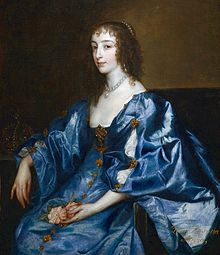
Henrietta Maria of France, Anthony van Deck

Charles succeeded to his father's throne at the age of 24. Two months later, Charles married a half-French, half-Italian Catholic, Henriette Marie of France.  Henriette Marie bore similarities to Charles's mother, not the least her habit of extravagant spending.  She also eerily reminded Charles's subjects of his ill-fated grandmother, Mary, Queen of Scots, who was Catholic and, culturally, decidedly French.  Henriette Marie was everything the English were not: cosmopolitan, witty, and frivolous.  Neither her hoity toity French customs nor her Catholicism endeared her to the English hoi poloi.  After all, the last Catholic queen the English had experienced had regularly burned Protestants in the streets of London.  The people came to hate her, much as the French public came to hate Queen Marie Antoinette in the next century.

Henriette Marie, ironically, was a youngest daughter. However, she brought with her to England a French custom of honoring the eldest daughter of the monarch with the title Madame Royale, or Princess Royal.  That and a shilling could have bought her an ale.  The English never appreciated her small contribution to their culture ... or her.

Henriette Marie, the daughter of a queen who was exiled, became an exiled queen herself in 1644. Henriette Marie, the daughter of a king who was assassinated before she was a year old, became the wife of a king who was executed before she was 40.

My next post will be about Mary, the daughter of Charles I, the first English Princess Royal.

Family tree of James I, including his children, Henry, Elizabeth, and Charles (Ancestry.com):